Loan API Orchestration vs. API Aggregation: Why the Architecture Decision Determines What Your Lending Stack Can Actually Do



Your engineering team can build an API aggregation layer in four to six weeks. It will pull data from your credit bureau, your KYC vendor, your document service, and your lender partners, normalize the responses, and return a single unified object to the frontend. It will work.
And for a loan origination workflow, it will be wrong.
The distinction between loan API orchestration and API aggregation is not an academic architecture debate. It is a question of which pattern matches the structural reality of a lending workflow, and building the wrong one means creating an integration stack that cannot enforce compliance timing, cannot track workflow state, and cannot execute the conditional logic that turns a multi-lender submission into a measurable approval rate lift.
The Difference Between Loan API Orchestration and API Aggregation - In Lending Terms
Both patterns involve multiple API calls. The similarity ends there.
API aggregation operates on a fan-out/fan-in model: one request triggers parallel calls to multiple independent services, responses are collected and merged, and a unified result returns to the caller. The calls are stateless — none depends on the result of another. The pattern is fast because the underlying services execute simultaneously without shared context.
Loan API orchestration manages a sequence of dependent API calls where the output of each step is the input to the next. It maintains state throughout the workflow, applies conditional logic at each branch point, handles failures with defined retry or rollback behaviors, and tracks progress from initiation to completion.
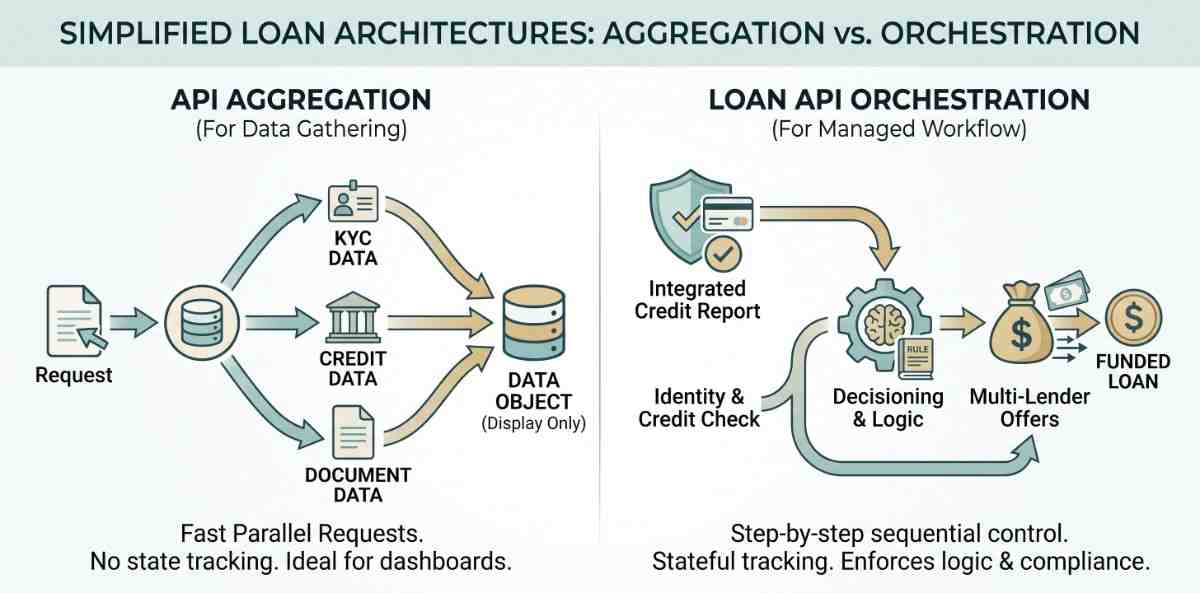
In a consumer lending workflow, the dependency structure is explicit at every step:
- Identity verification must succeed before the credit bureau pull initiates — pulling a file on an unverified identity is both a data quality failure and a regulatory exposure
- The bureau response determines which underwriting rules apply and which lender tiers are eligible for this applicant
- Underwriting evaluation must complete before any lender submission can proceed
- Lender responses must be received and normalized before TILA disclosures are generated — presenting a disclosure before the offer exists violates the Regulation Z timing requirement
- Borrower e-signature must be captured before the funding instruction is released to the merchant
None of these steps can execute in parallel without violating either the logical dependency between them or the regulatory sequence governing their order. That structural reality is the case for loan API orchestration in lending: this is not a data collection problem. It is a coordination problem.
Where API Aggregation Actually Fits in a Lending Stack
This is not an argument that aggregation has no place in lending infrastructure — it has a defined and valid role in specific contexts where the services called are genuinely independent, and the result is a display output rather than a workflow execution.
Aggregation is the correct pattern for:
- Borrower account dashboards — pulling current balance, payment history, application status, and available offers from separate services simultaneously; none of those calls depends on any other
- Merchant portal views — assembling pipeline metrics, origination volume, approval rates, and payment confirmation status from independent data sources for a unified reporting interface
- Portfolio analytics — pulling delinquency data, funded volume, and average ticket size across lender partners simultaneously for a consolidated performance view
- Offer display surfaces — presenting normalized lender offers to the borrower after the orchestration layer has already generated and validated them
These are legitimate aggregation use cases because the underlying service calls are independent. If the analytics call to one lender's reporting API fails, the dashboard renders with partial data and the failure is logged without disrupting anything downstream. Graceful degradation is a feature, not a risk.
The loan origination workflow shares none of those properties. A failure at identity verification does not produce a partial result — it stops the workflow. The absence of a bureau response means there is no application to route. These are not display problems with graceful fallback. They are binary success/failure gates that determine whether the next step is permitted to execute at all.
Where the Architecture Choice Shows Up in Outcomes
Approval rate mechanics. The most visible consequence of applying aggregation logic to an orchestration use case is approval rate loss at the multi-lender decisioning step. In a properly orchestrated lending workflow, a single application is submitted simultaneously to all eligible lender partners. The orchestration engine manages concurrent lender calls, normalizes divergent response schemas, and returns a ranked offer set to the borrower. The US digital lending market is projected to grow from $339.22 billion in 2026 to $592.87 billion by 2031 (Mordor Intelligence, United States Digital Lending Market, 2026). Lenders able to cover the full credit spectrum — prime through near-prime — capture a larger share of that origination volume. Those running architectures that cannot support simultaneous multi-lender submission cap their approval rates at a single credit box.
Compliance execution timing. Regulation Z's TILA requirements create hard timing constraints that a stateless aggregation layer cannot enforce. The disclosure must follow offer generation; it cannot precede it. Adverse action notices must be generated on decline and delivered within defined regulatory timelines. State licensing verification must confirm jurisdiction-specific eligibility before an offer is presented to the borrower.
In an orchestration architecture, these compliance events fire automatically when the workflow reaches the correct state — there is no manual trigger. In an aggregation architecture — which has no concept of "state in the workflow" — compliance execution becomes a manually managed exception queue. That queue is where regulatory exposure accumulates.
Decisioning speed without sacrificing sequence. A well-designed orchestration layer identifies which steps within the lending workflow can be parallelized without violating dependencies, and executes them concurrently. Identity verification and passive fraud screening, for example, can often run simultaneously — both can initiate without waiting for the other. The bureau pull triggers as soon as identity is confirmed. This is not aggregation. It is orchestration with strategic parallelism at dependency-safe steps.
The J.D. Power 2025 US Automotive Finance Digital Experience Study identified speed as one of the top criteria driving customer satisfaction in digital finance interactions. The lenders reaching fastest decisioning are the ones whose orchestration layers compress latency at eligible steps without sacrificing the dependency sequence that produces accurate and compliant offers.
Error handling and state recovery. When a bureau API is slow or temporarily unavailable mid-workflow, an orchestration layer applies defined retry logic, timeout thresholds, and circuit-breaker behavior before determining whether to hold the application, fail it gracefully, or route it through a fallback path. An aggregation layer has no concept of mid-workflow state to recover. When the loan origination call is stateless, a service failure mid-execution produces a failed response with no recovery path that preserves the progress made up to that point.
What a Correctly Structured Orchestration Architecture Looks Like at Scale
FinMkt's API Orchestration Engine was built around the sequential dependency structure of consumer lending workflows. It handles the complete origination sequence as a single managed workflow: identity and fraud verification, credit bureau pull, underwriting evaluation, simultaneous submission to all eligible lender partners, offer normalization and ranking, TILA disclosure delivery, e-signature, and funding release to the merchant.
Applications complete in under four minutes on average. Merchants are funded within 48 hours of origination. Across more than 150,000 consumers and $1 billion+ in annual funding volume, that consistency is an orchestration outcome — not a throughput ceiling.
The simultaneous multi-lender submission warrants a specific note: all eligible lenders receive the application at the same moment. Offers return concurrently. The orchestration engine normalizes divergent response schemas and presents a unified, ranked offer set. This is not sequential routing with a cascade fallback — it is simultaneous evaluation across the full lender network, with the approval rate ceiling set by the combined credit coverage of all partners rather than any single credit box.
Platform-level compliance management is embedded directly in the orchestration layer. TILA disclosures fire when the workflow reaches the post-offer-generation state — automatically, not on a manual trigger. Adverse action notices generate on decline without a human-initiated queue. State licensing checks execute as a pre-condition to offer presentation.
FinMkt is the technology layer — not the lender. The institution retains control over its underwriting configuration, financing program parameters, and borrower relationship through the embedded lending platform. The orchestration engine manages the coordination between every external service the lending program depends on, handling the sequencing, error recovery, and compliance execution that determines whether a single application event produces a funded loan or a dropped workflow.
The Compounding Cost of Getting This Wrong
Institutions that build aggregation patterns into orchestration use cases do not discover the problem at launch. They discover it during their first high-volume period, when workflow exceptions start accumulating faster than operations teams can clear them. They discover it in compliance reviews, when manual adverse action backlogs produce adverse examination findings. They discover it in approval rate reports, when multi-lender submission mechanics break down under concurrent load because the architecture was never designed to coordinate dependent service calls at scale.
Rebuilding an integration architecture is not a sprint-level fix. It is a platform rebuild — with the origination volume it was supposed to handle still going to competitors who got the architecture right the first time. In a US digital lending market projected to approach $592.87 billion by 2031 (Mordor Intelligence, United States Digital Lending Market, 2026), every quarter spent on that rebuild is origination capacity not deployed. The institutions that understand from the design stage that loan origination is a coordination problem — not a data consolidation problem — avoid that cost entirely.